
Who Should I Hire to Design My Kitchen Renovation?
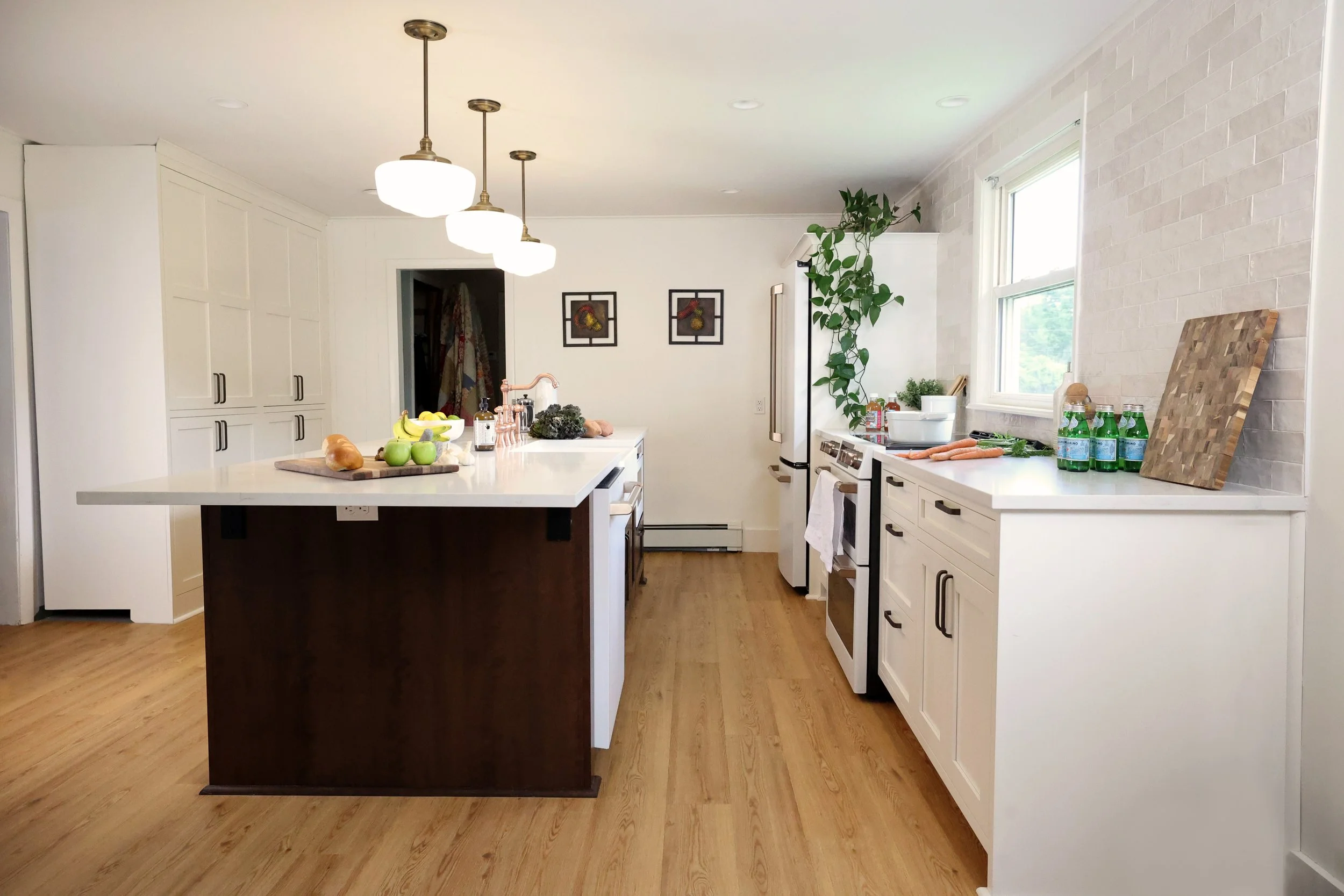
Architect vs. Structural Engineer vs. Designer vs. Contractor — And When You Actually Need Each
If you’re planning a kitchen renovation in Vermont — or reworking a bathroom in New Hampshire — especially inside a historic New England home, you’ve probably reached the point where you realize you’re not entirely sure who you actually need to hire.
You’ve likely spoken with a contractor. Someone may have suggested hiring an architect. The cabinet showroom has offered to “design” the kitchen. Maybe an engineer was mentioned if walls are coming down. And now you’re trying to sort out what each person actually does — and whether you need all of them, some of them, or just one.
Most homeowners aren’t confused about whether they need help. They’re confused about how these roles fit together. Renovations sit in this gray area between architecture, engineering, construction, and interior planning, and depending on the scope of the project, different professionals take the lead. What’s rarely explained is how those roles overlap — and where they don’t.
In historic New England homes especially, that distinction matters. The issue is rarely whether the house can structurally stand up. It’s whether the kitchen flows. Whether the bathroom layout makes sense. Whether the mudroom actually handles winter. And that difference — between structural adequacy and functional clarity — is where most renovation frustration begins.
The Type of Renovation Changes Everything
The first thing to understand is that not all renovations require the same team.
There’s a big difference between building a new home from the ground up and reworking a kitchen inside a historic New England home.
New construction almost always requires an architect. There are site plans, elevations, zoning considerations, structural systems, and comprehensive documentation involved. That’s architectural territory.
But most of the projects I work on aren’t new builds.
They’re hardworking spaces inside historic New England homes — 1890s farmhouses, early colonials, mid-century ski homes, houses that have been added onto two or three different times but never thoughtfully reworked.
Kitchens that were never meant for modern cooking. Bathrooms tucked into corners without considering flow. Mudrooms that evolved over decades without intention. These aren’t design problems in the aesthetic sense. They’re planning problems. And those projects live in a different category. That’s where the team structure shifts.
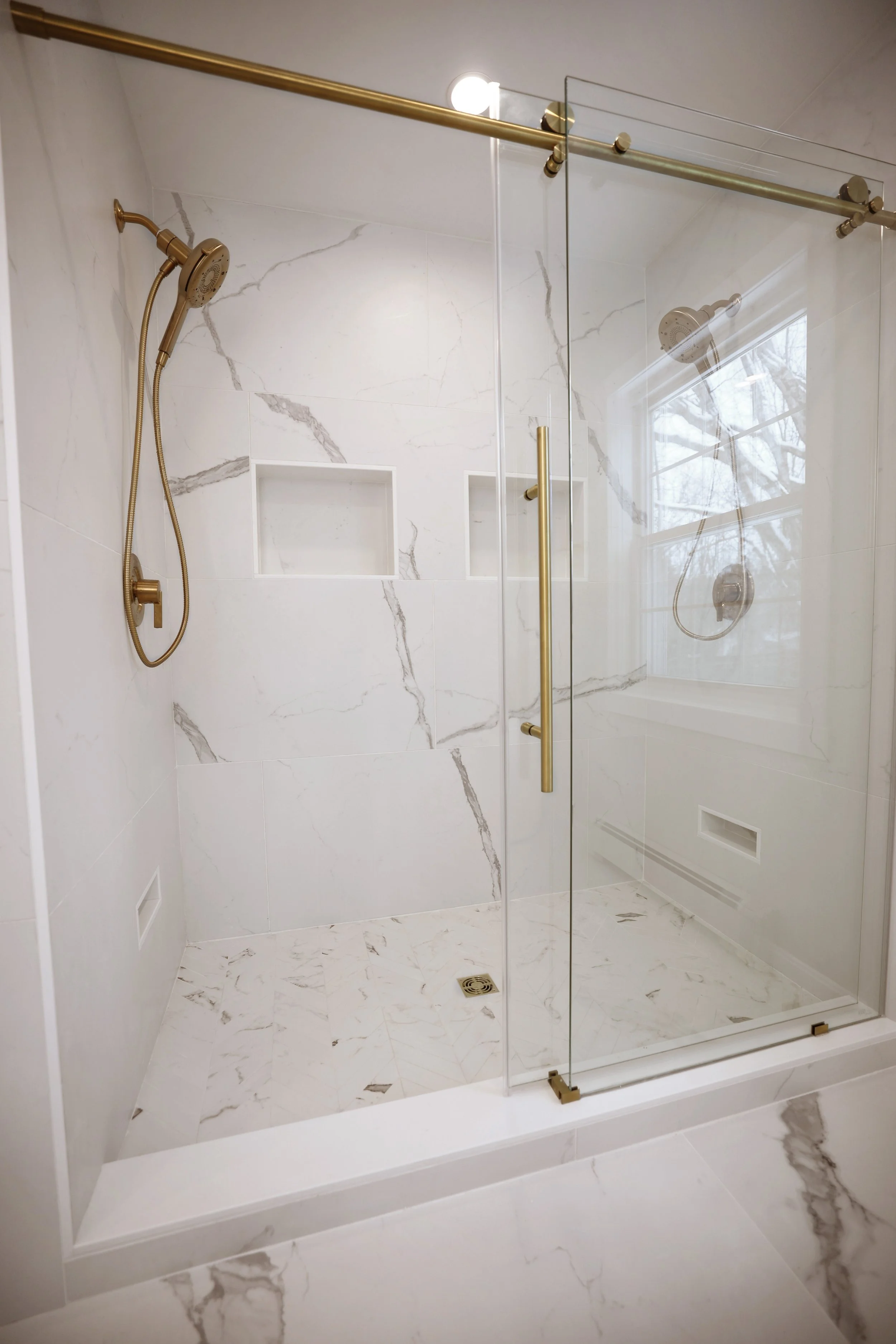
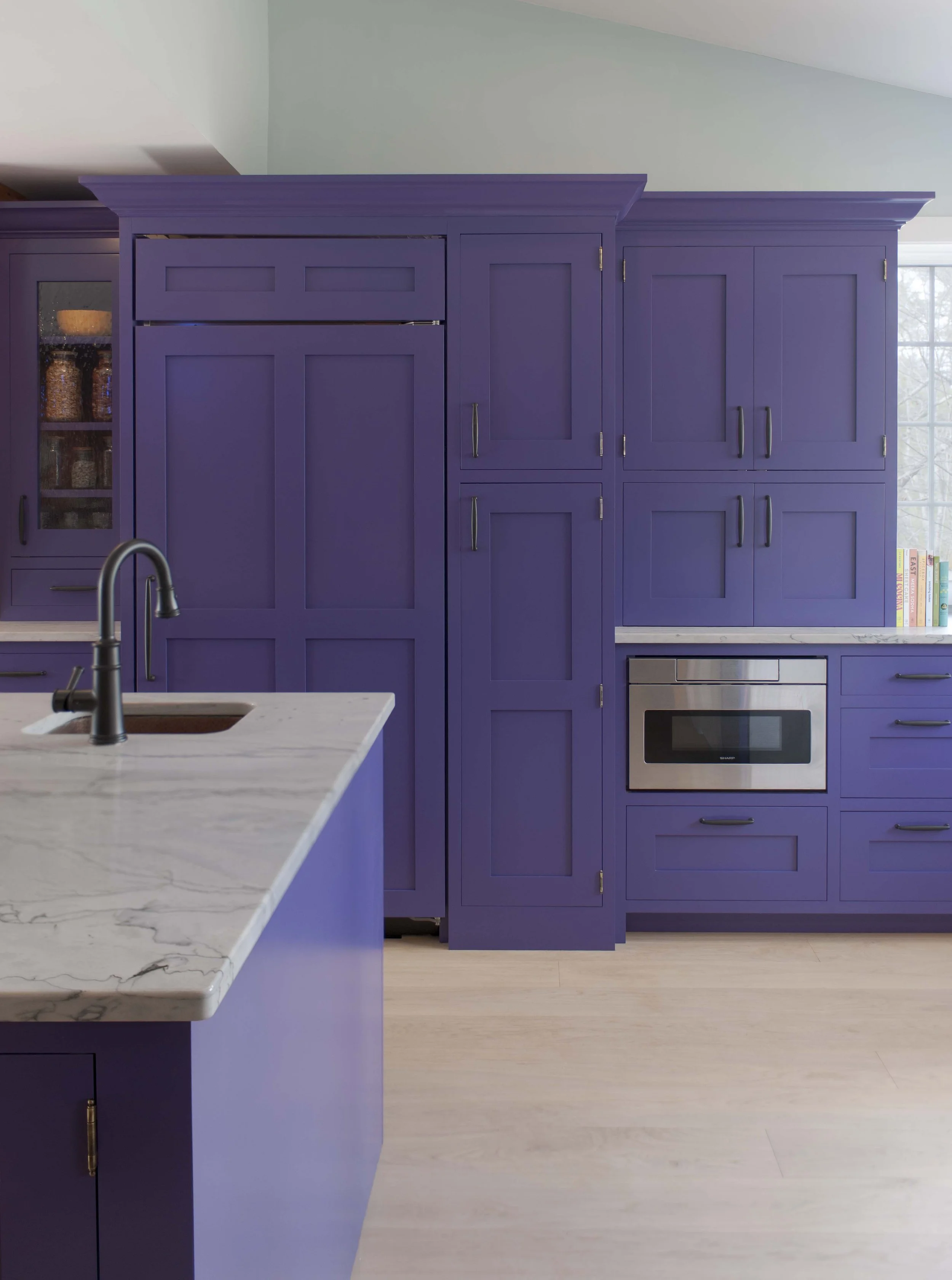

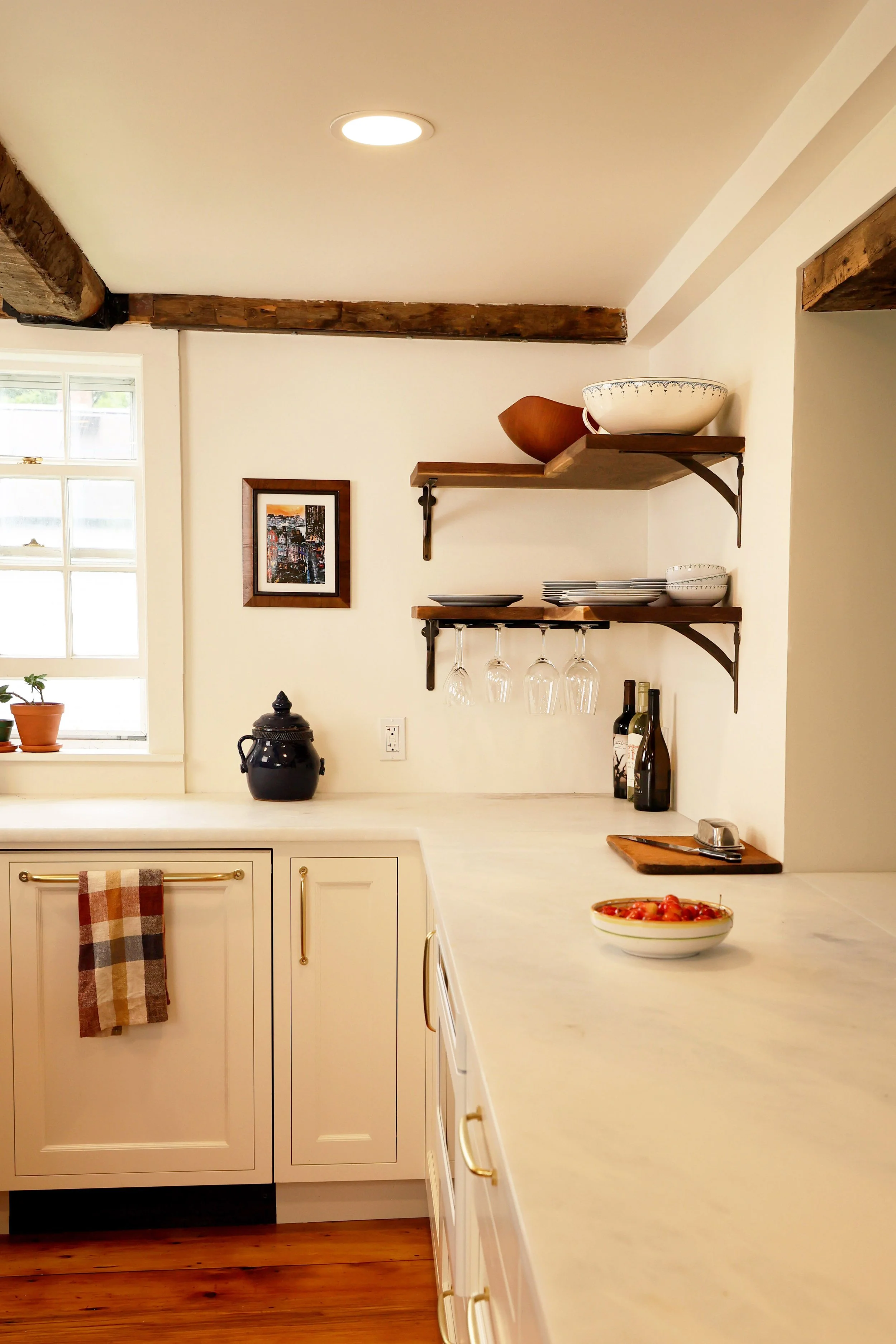
The Contractor Is Often More Central Than People Think
In residential renovations across Vermont and New Hampshire, it’s very common for a project to be led by a designer and a contractor.
That’s simply how many renovations work here.
Experienced contractors understand framing. They know how to identify load-bearing walls. They know how to install beams. They understand how older homes are put together. In many cases, they handle permitting as well.
Not every beam requires a structural engineer.
In straightforward situations, an experienced contractor has the practical knowledge to execute structural modifications properly. When conditions are more complex — unusual spans, deteriorated framing, post-and-beam structures, or when local permitting requires stamped documentation — that’s when an engineer is brought in.
The key is not automatically stacking professionals on top of one another.
The key is knowing when each one is necessary.
For interior kitchen and bathroom renovations inside historic New England homes, the team often looks like this: a designer resolving the layout, and a contractor building it — consulting engineering when the scope or town requires it.
That structure works extremely well when the layout has been fully thought through before construction begins.
Because while contractors know how to build it, they are not typically hired to step back and refine how the space actually functions day to day. That layer needs to be intentional.
Where the Structural Engineer Fits
Structural engineers are part of the conversation when a renovation moves beyond straightforward framing and into something more complex.
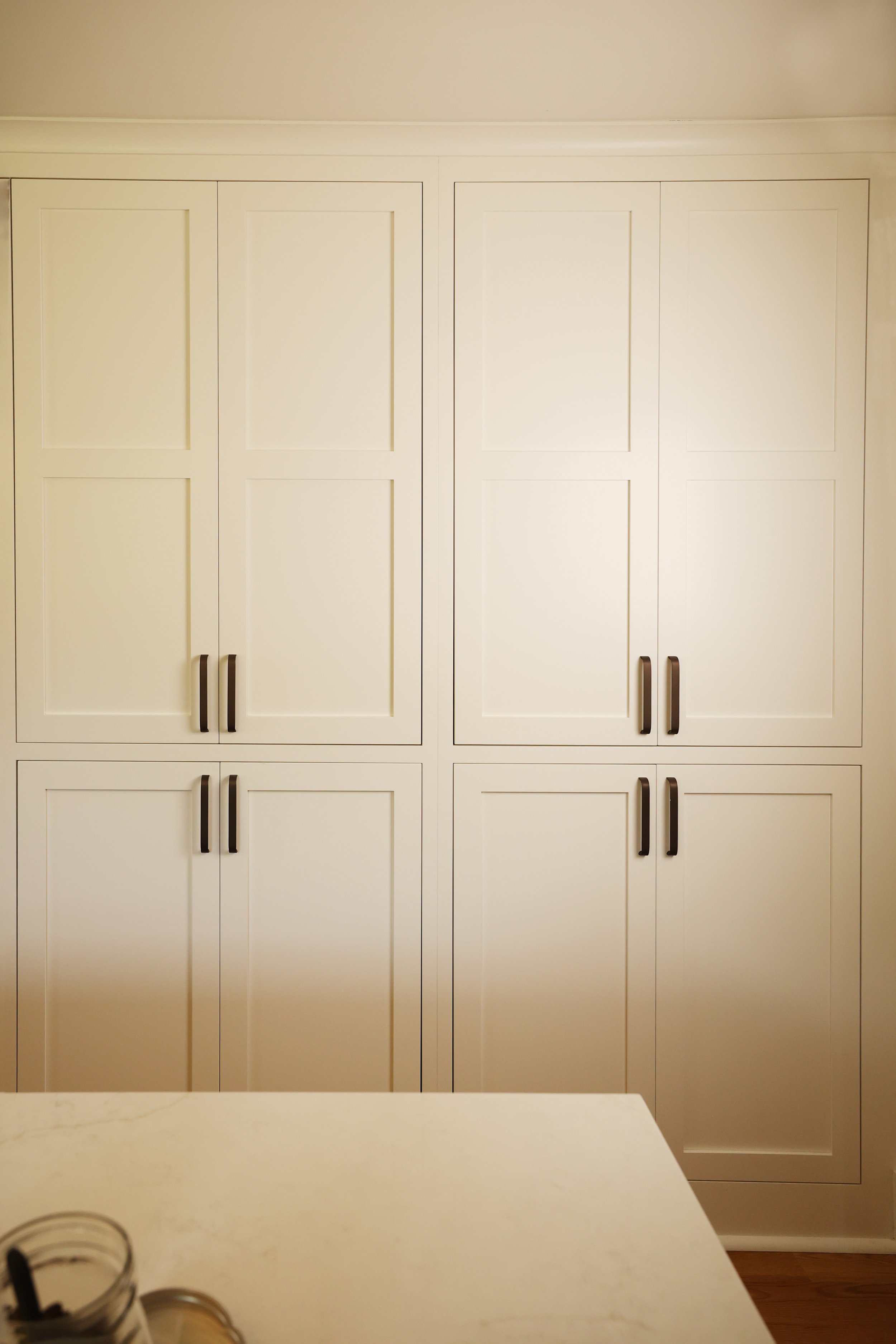
If you’re dealing with unusual spans, significant structural deterioration, post-and-beam construction, foundation reinforcement, or if the local building department requires stamped drawings, that’s when an engineer becomes essential.
Their role is very specific. They calculate loads, confirm beam sizing, validate structural changes, and provide documentation when required.
In some historic New England homes — especially very old Vermont farmhouses — homeowners choose to consult an engineer early simply to understand what they’re working with before any walls come down. That’s often about clarity and risk management, not overcomplicating the project.
But an engineer is not automatically required for every interior renovation.
And they are not designing your kitchen or bathroom layout.
They are confirming that the structural modifications are safe and appropriate.
That distinction matters, because structure and spatial planning are two different responsibilities.
When an Architect Makes Sense
There are absolutely projects where bringing in an architect is the right move.
New construction is one of them — especially custom homes where exterior design, site placement, massing, and overall building composition are central to the project. Architects are trained to think at the scale of the entire structure. They consider how the building sits on the land, how the exterior reads, how rooflines interact, and how all of those pieces coordinate in a comprehensive drawing set.
Architects are also often a good fit when a renovation significantly alters the exterior envelope of a home. Large additions, complex roofline changes, historic district approvals, or projects that require extensive documentation may benefit from architectural leadership.
But that doesn’t mean every residential renovation requires one.
In Vermont and New Hampshire especially, many homes are built and renovated without an architect involved at all. Contractors often lead construction. Designers handle layout. Engineers are consulted when structure becomes complex or when towns require stamped drawings.
The deciding factor isn’t the title.
It’s the scope.
If the project is primarily about reworking how the interior functions — correcting layout, improving flow, solving spatial problems — the leadership may look different than if the project is redefining the entire building.
Where Designers Actually Fit Into This
Part of the confusion around renovation comes from the word “designer.” It sounds straightforward, but in residential construction it can mean very different things depending on context.
For many homeowners, their first interaction with a designer happens in a cabinet showroom. And cabinet showroom designers are good at what they’re hired to do. They measure the existing space, design cabinetry that fits within the walls that are already there, help select door styles and finishes, and refine internal storage details. They may adjust an island slightly or shift appliance placement within the footprint.
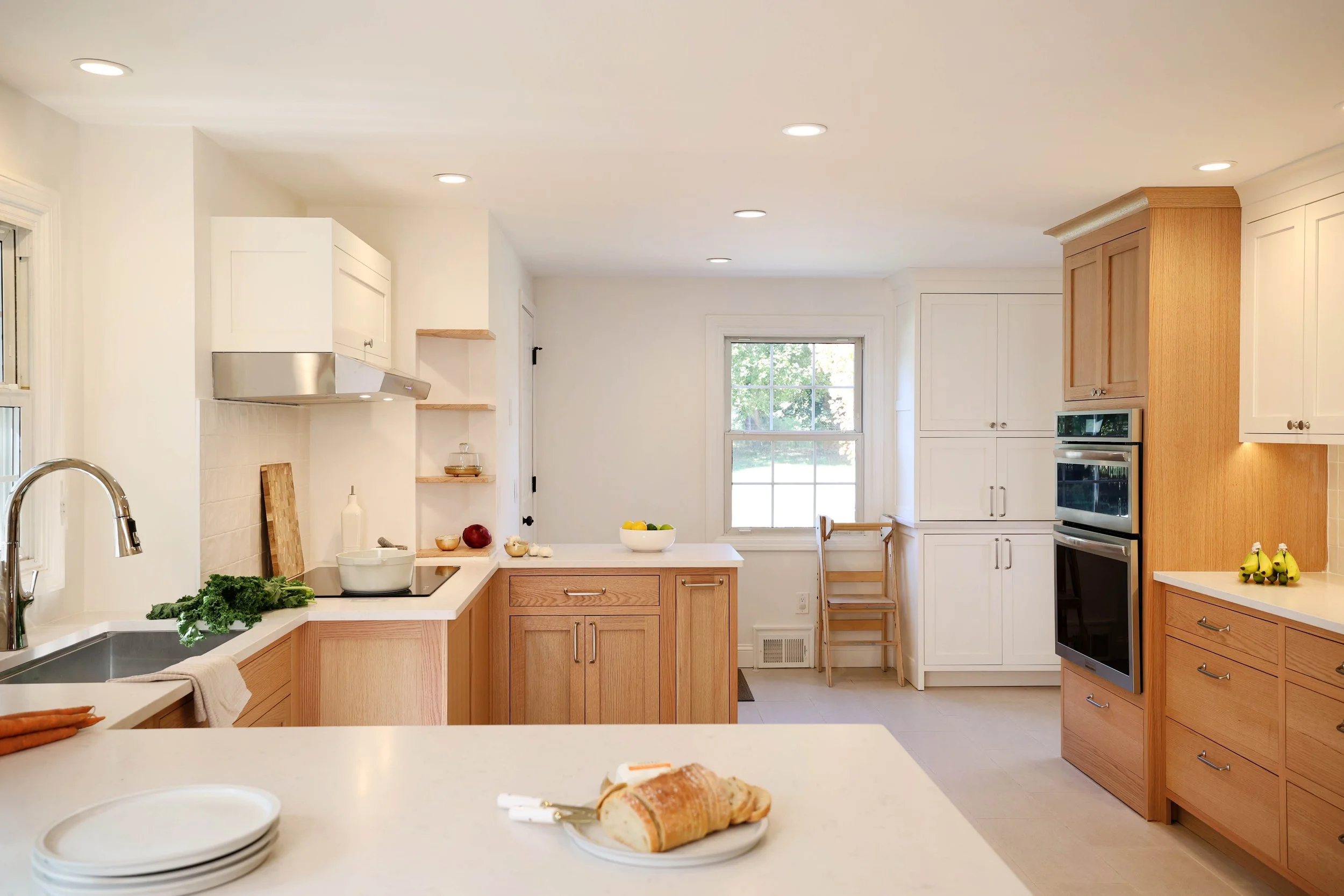
But they are typically working inside an assumed box.
They are not usually evaluating whether the footprint itself should change. They aren’t analyzing whether a wall could come down to improve circulation, whether a window could be added to improve light, or whether the kitchen should extend into an adjacent room. They’re not typically coordinating those possibilities with the contractor before the layout is finalized. Their role is to design cabinetry, not to rethink the structure of the space.
There are also interior designers whose work focuses primarily on aesthetics — material palettes, finishes, furnishings, overall cohesion. Some interior designers absolutely work in renovation at a deeper level, but many are not focused on spatial reconfiguration or construction coordination. They elevate how a space looks and feels, but they are not necessarily responsible for restructuring how it functions.
Neither of those roles is wrong.
They’re simply defined by scope.
Renovation design — especially in historic New England homes — operates in a different lane. It requires looking at the entire interior framework before cabinetry is drawn or finishes are selected. It involves understanding what can move, what probably shouldn’t, and what needs structural validation before it’s assumed impossible. It means thinking about plumbing stacks, ceiling heights, framing constraints, and traffic flow all at once.
Without someone intentionally leading that layer of planning, a renovation often becomes a replacement project rather than a spatial one.
The cabinets get upgraded. The tile changes. The appliances improve.
But the underlying layout remains largely the same.
And that’s usually why a newly renovated kitchen or bathroom can still feel slightly unresolved.
Where I Sit in This Conversation
My perspective on renovation didn’t start with finishes.
I started working for my dad’s commercial plumbing company when I was twelve. Summers and school breaks were spent around job sites — watching mechanical systems go in, seeing how framing and plumbing interact, understanding early that what’s behind the walls matters just as much as what’s in front of them.
Later, I became an engineer.
During college, I worked in both manufacturing and building systems environments, where process, sequencing, and documentation weren’t optional — they were critical. I also helped coordinate plumbing and mechanical systems for commercial buildings, reviewing drawings and verifying specifications against code.
After graduation, I worked as a mechanical engineer for the U.S. Navy, supporting gas turbine propulsion systems on active ships. That role involved inspecting complex systems, reviewing technical drawings, coordinating between contractors and government teams, and solving real-time system issues during testing and integration.
All of it reinforced the same principle: buildings — like ships — are systems.
Structure, mechanical, electrical, sequencing, coordination — everything interacts.
What that gave me, more than technical experience, was a systems mindset.
I don’t look at a kitchen or bathroom as a collection of cabinets and finishes. I see it as a coordinated system — structure, plumbing, electrical, lighting, circulation — all interacting at once. I understand framing logic. I understand what happens structurally when a wall moves. I understand how plumbing stacks affect layout flexibility and how ceiling heights or beam drops change how a room feels. I understand how contractors think because I grew up around it.
That combination — construction fluency and systems-level thinking — is what allows me to evaluate a historic New England home and see not just what’s there, but what’s possible.
Why Timing, Role Clarity, and Specialization Matter
Most renovation problems don’t begin with poor craftsmanship. They begin earlier, in planning.
When decisions about layout, structure, and finishes happen in separate conversations — or at different stages — small compromises get built in before anyone realizes they’re happening.
A wall is assumed to stay because no one has evaluated whether it could move. Cabinetry is designed before the full footprint is reconsidered. Permits are submitted before circulation has been fully resolved. Structural changes are validated without stepping back to ask whether the new opening actually improves how the space functions.
None of this happens because people aren’t capable. It happens because responsibility isn’t clearly defined.
Kitchen and bathroom renovations, especially in historic New England homes, require someone whose primary focus is the interior spatial logic of the room. Not just cabinetry. Not just finishes. Not just structure.
Cabinet showroom designers are typically working within an existing footprint. Contractors are focused on buildability. Engineers validate structure. Architects may be focused on the building as a whole.
But kitchens and bathrooms are highly functional systems. They require someone who specializes in how those rooms work — how inches affect circulation, how plumbing affects layout flexibility, how light interacts with ceiling height, how adjacent rooms connect.
That specialization is what prevents a renovation from becoming a replacement project.
When a layout is intentionally resolved before construction begins — in coordination with the contractor and, when necessary, engineering — the rest of the project moves more cleanly. Structure supports the plan. Construction follows a clear direction. Fewer reactive decisions happen midstream.
Early alignment isn’t about adding more professionals than necessary. It’s about making sure the right layer of thinking is happening at the right time.
And in kitchens and bathrooms, that layer is almost always layout.
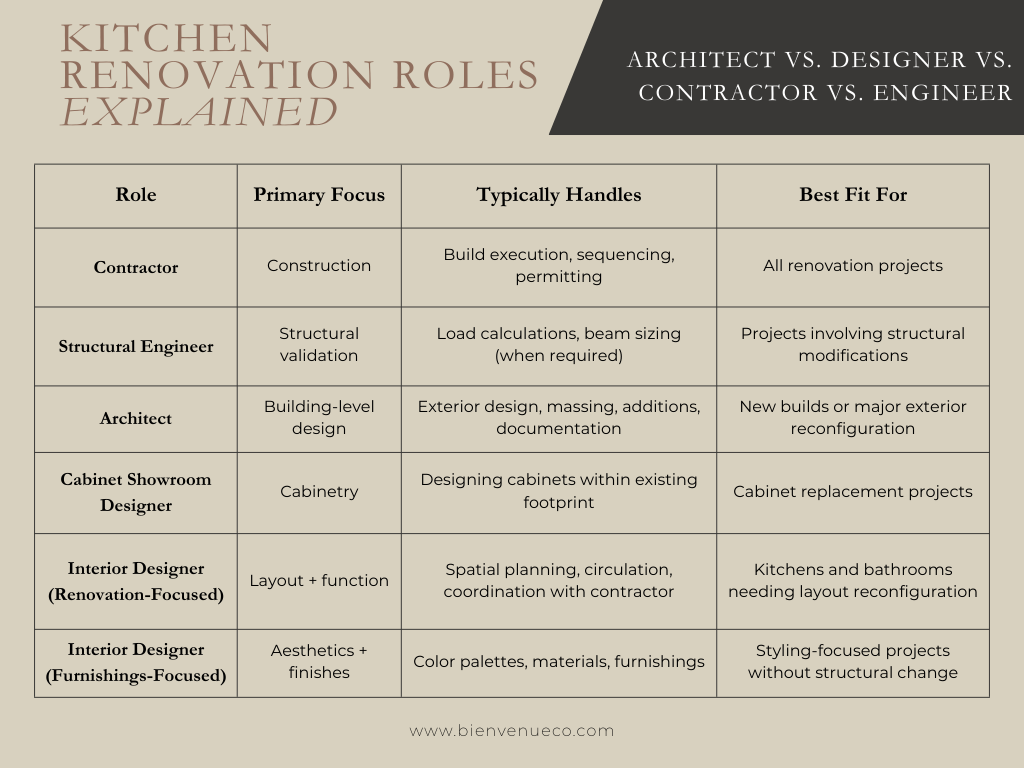
A Simple Way to Think About It
If you’re still unsure who you need, here’s a table showing a simplified breakdown of how these roles typically function in residential renovations across Vermont and New Hampshire.
This isn’t about hierarchy. It’s about scope.
Not every project requires every professional. But every project benefits from clearly defined roles — especially when it comes to who is responsible for resolving the layout.
What This Means for Your New England Renovation
The difference between a renovation that simply updates a space and one that genuinely improves how it functions usually comes down to whether the layout was intentionally resolved before construction began.
In historic New England homes especially, kitchens and bathrooms often need more than new cabinets, new tile, or upgraded fixtures. They need rethinking. They need someone looking at structure, light, circulation, and daily routines at the same time — and coordinating that with what can realistically be built.
If what you’re hoping for is a renovation that actually makes your kitchen or bathroom make sense — not just look new — then the person leading the spatial planning matters.
That’s the work I specialize in.
If you’d like to explore your project further, the first step is to fill out my intake form and tell me about your space. I review each inquiry personally. If it looks like we’re a good fit, we’ll schedule a call to talk through your goals, your home, and what level of design support makes the most sense.
A renovation is a significant investment. It’s worth making sure it improves how your home functions — not just how it photographs.
